Monday, January 6, 2014

Tamiya Egress (2013 re-release)

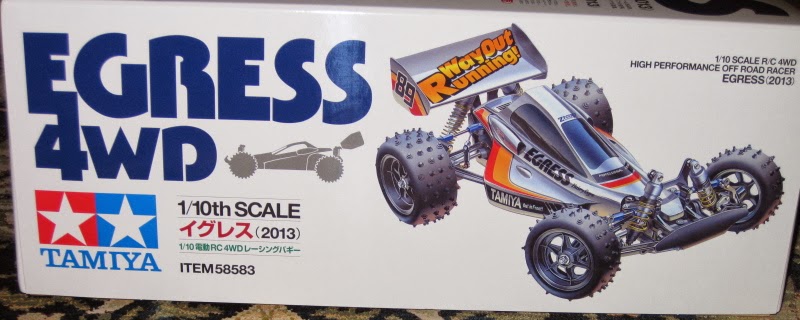
Once again Tamiya has re-released a model that many will remember as something they wished they had but could never afford back in 1989 when it first came out.  The Egress (58583), a revision of the Avante chassis that was designed to be more durable and lighter in weight, was released near the end of 2013 with much excitement from Tamiya fans world wide.

Tamiya Egress (2013) (Picture from TamiyaUSA. © Tamiya, Inc.)

The box art is the same as the original even though the kit parts have changed a bit in this re-release.  For example, the blue rod ends of the original are now black, and the front uprights are gold like the 2011 Avante re-release instead of grey.  There are many other changes and enhancements designed to improve the performance and durability of the chassis as compared to the original.




Once the cover is removed, the two blister packs and center body section are right there begging to be opened and built. 
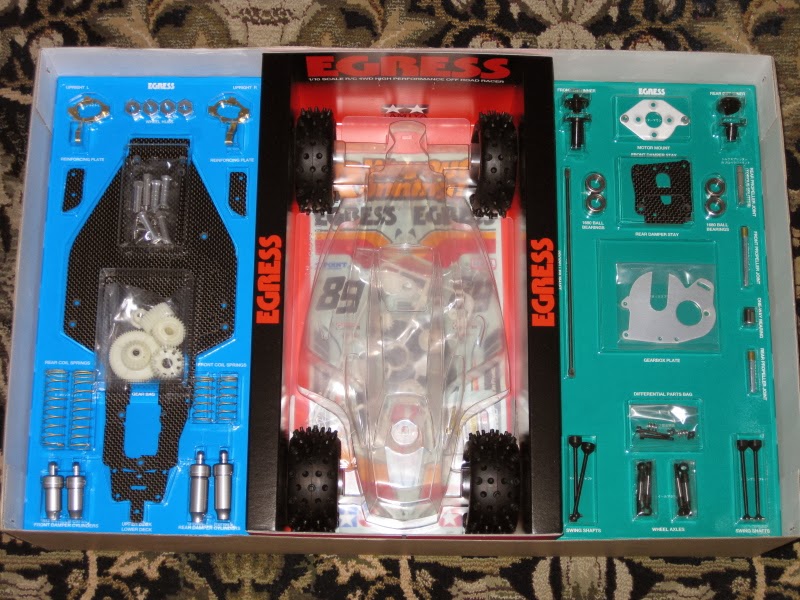

Tamiya used blister packaging for the re-release just like the original did, however some of the contents have changed for unexplainable reasons which drew some criticism from some fans (yours truly included).  The biggest complaint is about the green blister.  The large center blister in the original kit held the ball bearings in foam to make for a nice presentation but the re-release blister contains the gearbox plate instead.  But the blister wasn't changed to fit the smaller part, so it slides around.  What makes it especially odd is that the re-release kit contains full ball bearings just like the original, however Tamiya decided to not put them on display in the blister.  Perhaps the purpose of this was to ensure that vintage kits were easily distinguishable from the re-release.  Or the ball bearings were already part of other parts bags and would have been a pain to put them into foam for the blister.  Keeping costs down was likely a priority for this release although this is still quite an expensive model.  The pinion gears were also removed from the re-release.  You'll note the space where they used to be just below the gearbox plate blister.


I'm sure many people are thinking "who cares?" as they read this, and they are right, of course.  In the grand scheme of things it doesn't matter.  It is incredible that Tamiya has re-released the Egress and I am extremely happy to own one.  It was another one of those models that was simply out of reach back when it first came out and became highly sought after as a vintage model and kit (if you could find one).

The carbon fiber plates are gorgeous

The presentation of the body and wheels was unique compared to other kits of the day.  Tamiya had designed the extra plastic flashing on the four corners of the body to be able to hold the tires as if there were wheels.  Definitely a cool look.


No motor is included, just like the original kit, however a 22T 0.6mod pinion gear is included.  It is recommended to replace the pinion with an aftermarket steel one, such as Robinson Racing #1122.  Also, no speed control is provided, unlike most US Tamiya kits. 


Watching the discussions on TamiyaClub, it is quite apparent that this kit is extremely popular among Tamiya fans.  The first run of kits sold out rather quickly leaving many to wait for the second batch to arrive at hobby shops and online stores well into late December 2013.  Stock does not seem to be a problem now.

The Egress was certainly a nice surprise considering the Avante and Avante Black Special were released on a very similar chassis.  I look forward to seeing what Tamiya re-releases next.


Monday, December 2, 2013

Team Associated RC10 Classic (2013 re-release)

Team Associated has re-released the RC10.  The classic, original, gold anodized stamped aluminum tub with white plastic suspension arms and 6 gear transmission that changed the RC racing world forever in 1984.  Associated part number 6001.


It is now only two months after release and this limited-production kit is already sold out at many online retailers and is becoming harder to find at local hobby stores.  Actual production numbers were not disclosed, but some people think the total number of kits produced was around 2500.  Many people were surprised at how quickly the kits were bought up, and others were shocked and disappointed at how the allocation and distribution of the kits was handled.

The box presentation is similar to the original.  Associated used the same picture of the RC10 flying through the air off a dirt mound as the original box.  The parts are very similar to the original, too, but with some updates necessary for 2013, such as the ability to handle mild brushless motors and LiPo battery packs.  Other more subtle modifications were made to most parts in order to differentiate the re-release parts from original parts, which is a good thing for vintage collectors and restorers.


One thing to note here is that the re-release kit was not made in the USA like the original, at least not all of it.  Some parts were made in the US, such as the tires (by Proline) and gold anodized aluminum parts, but the rest of the parts were manufactured somewhere else, like China.  The actual kit boxing was done in China.


When the kit box is opened, you are greeted by a sight very similar to the original.  Many bags of parts.


Proline tires and three-piece wheels

The original kit included bushings and so does the re-release.  It is highly recommended to purchase ball bearings in order to reduce wear and friction.  You will need the following ball bearings:

Inner diameter Outer diameter Style Quantity
3/16" 5/16" flanged 9
3/16" 5/16" unflanged 2
3/8" 5/8" unflanged 2
1/4" 3/8" flanged 5

The original kit used a 32P spur gear, but the re-release uses a 48P spur.   The internal gears, however, are still 32P.   

The kit does not include a motor or 48P pinion gear.  The recommended pinion size is around 18 teeth when using a 27T stock brushed motor.  Associated does not recommend using a brushless motor less than 8.5 turns.

Six gear transmission, rear arms and battery holder

Shocks, spur cover, ball ends, steering parts and shock tower

Tie rods, gold aluminum nose and motor plate, front suspension parts

Gold anodized aluminum tub

Driver and rear wing

Body

A slip of paper like this one is included in each kit box.  Parts bags were checked off as each one was added to the box.  The online forums have already determined that the number at the bottom (2216) is not the kit number because many people have the same number.  It is likely to be the identification number of the person that performed the box contents inspection (quality assurance).

Quality control sheet

Decals, manual and antenna tube

Two different sets of decals are included. 

Decal sheets

The manual is similar to the original but has been updated for the re-release.

Assembly manual

There are some assembly issues to be aware of.  The RC10 experts at RC10Talk.com have compiled a list at this link:  http://www.rc10talk.com/viewtopic.php?f=88&t=33130
In addition to that excellent reference, there are many other threads discussing the re-released RC10, so feel free to check them out and post your own experiences and opinions.

As for spare parts, Team Associated has stated that there will be plenty of spares available for a long time, so there should not be any worries of not being able to get spares of broken or worn out parts.  


Due to the plethora of spare parts availability it is possible to "build your own kit", given that the re-release kit is now hard to find, however the cost of doing so would be much higher than the kit price of $250 US.
 

In addition to spare parts, Team Associated has released hop-up parts for the RC10 Classic, as it is called, including black anodized aluminum tub, motor mount and nose plate, bellcrank steering kit, and more.  There is speculation that a re-released stealth transmission will be available in the future.

As a long-time Tamiya fan who has thoroughly enjoyed the re-releases over these past few years, I am glad that Team Associated decided to re-release the RC10.  It is truly a classic racing vehicle that changed how future car designs would be made and it's nice to be able to build one from scratch.

Monday, October 28, 2013

Tamiya Neo Scorcher (TT-02B)

When Tamiya announced the Neo Scorcher (58568) in early 2013, I fell in love with the shape and styling of the body and the blue and white colors of the paint and decals.

Tamiya Neo Scorcher (Picture from TamiyaUSA. © Tamiya, Inc.)

I later learned (from Tamiya's own description) that the Neo Scorcher was inspired from the vintage Terra Scorcher (58075) and the decals were based on that kit's design.

The Neo Scorcher is based on the new TT-02 chassis platform from Tamiya, specifically the TT-02B (Buggy) variant.  The "B" version has longer suspension arms, long CVA dampers and larger bumpers than the TT-02, plus buggy-specific off road wheels and tires and a buggy body and wing to match.

The TT-02 chassis is designed for entry-level bashing and racing, not competition.  It has plastic, non-adjustable suspension links, plastic dogbones and drive hubs (with metal shafts molded into them), plastic (glass filled) diff gears, and a plastic center driveshaft to send power to the front wheels.  All of this plastic makes it sound "cheap", but honestly the quality and strength of the plastic is higher than you'd expect and the molding quality is excellent.  Sure, it's still a low-end chassis, but made to take abuse and keep going.  It also supports many hop-ups to increase performance.  All accounts so far from people that have built it say that it's a solid chassis, fun to build and drive, and it's tough.

The box does not have the traditional styling with the big size and large colorful artist's rendition of the vehicle on the cover like you might expect.  Instead, it's similar in design to the DF-03RA box.  The basic box styling is of a generic TT-02B chassis (no body shown anywhere) with a sticker on the box top displaying a photograph of the actual model contained inside.  This makes it easy for Tamiya to release another TT-02B-based buggy by simply swapping the picture and putting a different body/wing/decals/body instruction sheet in the box (more about that later).

The picture of the Neo Scorcher is actually a sticker applied to the box top.

One interesting thing about the Neo Scorcher is that it includes the Mabuchi RS-540 Torque Tuned motor instead of the regular silver can RS-540 (Mabuchi or Johnson).  This 25 turn motor gives 306 g-cm of torque @ 16000 rpm compared to the stock 27 turn RS-540 that gives around 200 g-cm of torque @ 15000 rpm.  That's 50% more torque and a slightly higher speed at the cost of higher current usage.  These days with high capacity NiMH and LiPo batteries, however, run time is almost never an issue any more.


The TT-02 chassis is a shaft driven 4WD design.


Some of the hop-ups supported by the TT-02B chassis are shown on one of the side panels.


Opening the box reveals a standard assortment of parts bags, plastic trees, wheels and tires, plus the body and wing.


In the US, the kit includes a TEU-105BK electronic speed control (ESC).  The TEU-105BK replaces the TEU-104BK as the current model of speed control (as of Oct 2013) shipping with US Tamiya kits.  It adds a voltage regulation circuit (BEC) so power supplied to the receiver will not exceed 6V, which is a welcome feature that was missing from previous Tamiya ESC models (101BK and 104BK).  Unfortunately, Tamiya still refuses to acknowledge the existence and dominance of LiPo batteries by only including voltage cutoff for LiFe batteries in the 105BK.  The cutoff voltage of LiFe batteries is too low for 2 cell (7.4V) LiPo packs and they will be ruined if you attempt to use it.   You'll still need to purchase a separate LiPo voltage alarm if you intend to use LiPo packs with the TEU-105BK.


In the next picture, you'll see the separate instruction manual for the body.  Normally, Tamiya kits include the instructions for the body (trimming, painting, etc.) right in the chassis instruction manual.  However, the TT-02B series instruction manual is generic in nature when referring to the body, instead telling you to refer to the body-specific manual for details on how to finish the body and wing.


The instruction manual is generic for all TT-02B models.  No body-specific information is included because a separate body instruction manual is included with each kit instead.


For some reason this kit took a long time to become available to purchase in the US.  It was many months after release that I was finally able to get one.  Not sure what caused the delay, but I'm glad to finally have a kit in my hands.